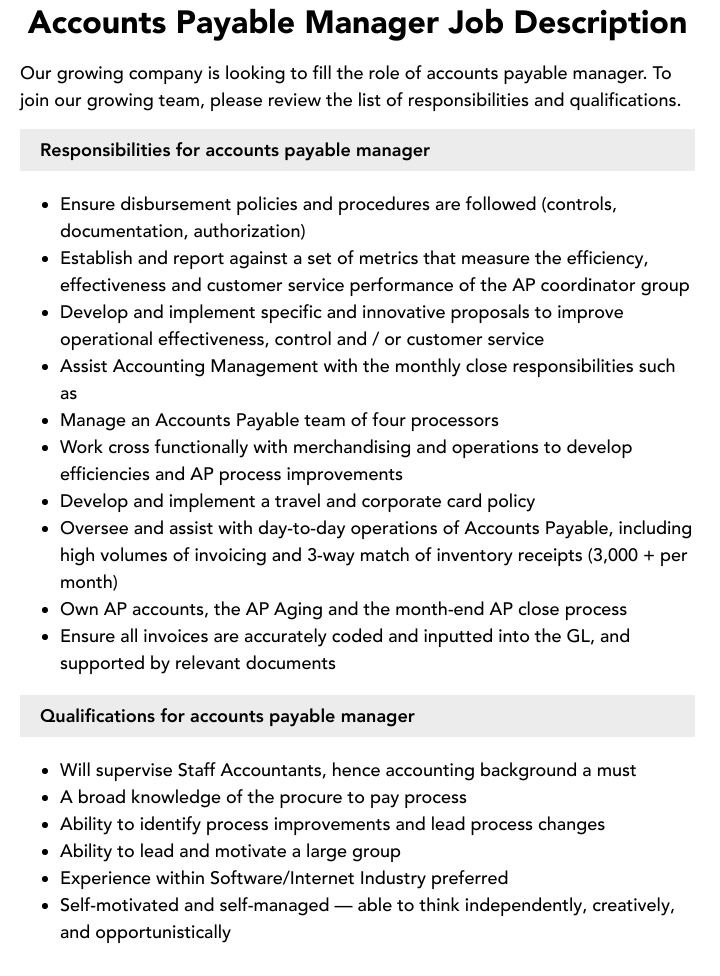
In 2025, the role of an Accounts Payable Manager remains a cornerstone of corporate finances. This position combines leadership, precision, and strategic thinking to ensure that invoices are processed accurately, payments are delivered on time, and vendors are managed effectively. A skilled AP manager not only keeps the books in order but also strengthens cash flow, reinforces internal controls, and contributes to the organization’s financial resilience. As supply chains evolve and regulatory expectations tighten, the need for reliable, compliant, and forward-looking accounts payable leadership has never been greater. This guide unpacks what the role entails, why it matters, and how to pursue success in this dynamic field, with practical insights drawn from real-world finance operations in 2025.
En bref
- Accounts Payable leadership directly influences Cash Flow Management and supplier relationships.
- Strong focus on Invoice Processing, Compliance, and Financial Reporting drives accuracy and accountability.
- Career paths combine process optimization, vendor negotiations, and team leadership in a structured environment.
- Professional growth hinges on certifications and hands-on mastery of industry-standard software.
- Demand for skilled AP managers remains robust, with competitive compensation and clear advancement routes.
What does an Accounts Payable Manager do and why is the role critical in 2025
The Accounts Payable Manager oversees the entire lifecycle of outbound financial obligations. From receiving and validating invoices to ensuring timely payments, this role safeguards the organization’s liquidity and supplier trust. A proficient AP manager aligns the procure-to-pay process with the company’s Budget Control and Compliance requirements, while extracting insights from data to support strategic decisions. By maintaining Financial Accuracy and robust internal controls, the AP leader reduces risk, minimizes errors, and enhances the company’s financial credibility.
| Aspect | Why it matters | Typical activities |
|---|---|---|
| Invoice Processing | Ensures accurate recording of expenses and timely payments. | Invoice validation, coding, approvals, and workflow management. |
| Vendor Management | Maintains strong supplier relationships and favorable terms. | Vendor onboarding, term negotiation, dispute resolution. |
| Payment Processing | Protects cash flow and avoids penalties for late payments. | Scheduling payments, early payment discounts, batch processing. |
| Internal Controls & Compliance | Prevents fraud and ensures regulatory alignment. | Segregation of duties, audit trails, policy enforcement. |
| Financial Reporting | Offers visibility into spending and cash requirements. | Cash flow forecasting, variance analysis, management reporting. |

Direct impact on Cash Flow Management
As an Accounts Payable Manager, you shape the company’s Cash Flow Management by controlling when and how money leaves the business. Your decisions on payment timing and supplier terms influence liquidity, creditworthiness, and long-term growth. You negotiate terms that optimize working capital while maintaining strong vendor partnerships and avoiding penalties.
- Timely payments protect supplier trust and avoid late fees.
- Negotiating favorable terms improves working capital and flexibility.
- Accurate record-keeping supports reliable cash flow forecasts.
Between sections, consider how daily duties translate into broader financial health and strategic value for the organization.
Opportunities for Strategic Financial Planning
AP leadership extends beyond processing. You have the chance to influence Budget Control, cash budgeting, and long-range planning. By analyzing expense patterns, forecasting future costs, and identifying risk factors, you guide the business toward prudent investments and optimized resource allocation. This strategic lens makes the AP manager a key partner for finance leadership.
- Forecasting future outflows helps prevent liquidity crunches.
- Cost optimization through supplier terms and discounts supports profitability.
- Finite data interpretation informs board-level decisions.
Note how streamlined processes reduce cycles and elevate overall financial discipline.
Integral Part of the Procure-to-Pay Cycle
You oversee the complete procure-to-pay cycle, ensuring that procurement, invoicing, and payment flow smoothly. This end-to-end oversight supports Financial Reporting, reduces cycle times, and minimizes discrepancies. Your work underpins profitability by aligning expenditure with strategic goals and ensuring timely settlements with vendors.
- Aligns purchasing with budget targets.
- Improves vendor terms through proactive management.
- Strengthens internal controls across the cycle.
| Process Step | Expected Outcome | Key Metrics |
|---|---|---|
| Procurement | Validated requests and compliant PO issuance. | PO accuracy, cycle time, spend under policy. |
| Invoicing | Accurate invoice capture and matching. | Three-way match success rate, exceptions. |
| Payments | On-time, accurate disbursements. | Days Payable Outstanding (DPO), penalties avoided. |
Collaboration with Various Departments
Successful AP management thrives on cross-functional collaboration with procurement, logistics, and sales. Close coordination improves data accuracy, accelerates approvals, and supports transparent reporting. This teamwork also helps harmonize policies and strengthens overall governance.
- Joint process improvements with procurement for faster invoicing.
- Shared dashboards with finance and operations for alignment.
- Clear escalation paths for payment disputes to protect supplier relationships.
Vendor Relationship Management
Vendor relationships are foundational to reliable operations. An AP Manager maintains trust with suppliers by ensuring fair treatment, transparent communication, and timely payments. Negotiating favorable terms can unlock discounts or extended payment periods, boosting margin and resilience.
- Timely payments reinforce supplier loyalty.
- Dispute resolution protects ongoing cooperation.
- Negotiated terms improve overall cost efficiency.
Fraud Prevention and Financial Controls
Internal controls protect assets and maintain integrity. Your role encompasses auditing, reconciliation, and policy enforcement to deter fraud and errors. A strong control environment supports audit readiness and regulatory compliance, reinforcing stakeholder confidence.
- Robust approval workflows prevent unauthorized payments.
- Audit trails enable traceability for audits and investigations.
- Regular reviews identify and rectify anomalies quickly.
Mastery of Industry-Standard Accounting Software
Proficiency with Accounting Software is essential. Mastery of these tools boosts Financial Accuracy, accelerates Invoice Processing, and reduces risk of penalties. Staying updated with technology ensures the department remains compliant with evolving standards.
- Automation features reduce manual data entry.
- Workflow customization speeds approvals.
- Integration with ERP enhances data consistency.
Essential in Ensuring Timely Payments and Optimizing Discounts
You ensure that obligations are settled promptly while seeking early payment discounts and favorable terms. This disciplined approach improves supplier relations and contributes to Cash Flow Management and overall profitability.
- Implement early payment discounts where beneficial.
- Schedule payments to align with cash availability.
- Monitor terms to maximize savings across vendors.
Developing and Implementing Efficient Payment Processes
Designing reliable, scalable payment processes is a core capability. An efficient system reduces errors, strengthens internal controls, and supports predictable liquidity. You continuously refine workflows to keep pace with growth and regulatory change.
- Standardize data capture and validation.
- Automate duplicate checks and reconciliations.
- Document procedures for continuity and training.
Leadership Opportunities in a Financial Team
Leading the AP team builds managerial experience, mentorship, and strategic influence. You set performance goals, drive process improvements, and cultivate a culture of accountability. This leadership track often serves as a stepping stone to broader finance leadership roles.
- Mentor junior staff and promote cross-training.
- Define KPIs and monitor progress with regular reviews.
- Champion process innovation across the finance function.
Professional Growth through Certifications and Trainings
Continual learning is a hallmark of success. Certifications in accounting and procurement can elevate credibility and unlock advancement opportunities. Training keeps you current with regulations and best practices in AP management.
- Certifications like CPA, CAM, or CPP may be beneficial depending on the company.
- Targeted training on ERP systems and automated AP workflows.
- Participation in industry events supports network building and knowledge sharing.
Analytical Skill Enhancement
The role sharpens analytical thinking through data-heavy work. You analyze large datasets to detect discrepancies, forecast cash needs, and support decision-making with evidence-based insights.
- Perform variance analysis between forecasted and actual cash outflows.
- Identify cost-saving opportunities and process inefficiencies.
- Develop dashboards that communicate complex information clearly.
Opportunity to Develop and Enforce Corporate Policies
You can shape policy by establishing standards for invoicing, approvals, and payment terms. Enforcing these policies promotes financial discipline, reduces risk, and creates a culture of transparency and accountability across the organization.
- Draft and socialize AP policies and controls.
- Ensure compliance with relevant laws and regulations.
- Implement periodic policy reviews and updates.
Contribution to the Organization’s Financial Health
Through precise payment management and strategic insights, the AP Manager safeguards financial health and supports sustainable growth. Accurate records, timely reporting, and disciplined spend controls translate into clearer budgeting and stronger stakeholder confidence.
- Accurate aging reports enable proactive supplier communication.
- Forecasting informs capital planning and risk mitigation.
- Transparent reporting builds trust with leadership and auditors.
Ability to Influence Cost Savings and Business Efficiency
Your discipline in overseeing expenditures and optimizing processes directly affects profitability. By reducing waste, streamlining workflows, and leveraging supplier negotiations, you drive meaningful efficiency gains across the finance function.
- Identify duplicate payments and reconciliation gaps.
- Automate repetitive tasks to free up team capacity.
- Benchmark performance against industry standards to target improvements.
Recognition for Maintaining Auditable Records
Maintaining auditable, transparent records is essential for audits and compliance. Your meticulous documentation reassures stakeholders and supports regulatory scrutiny when needed.
- Maintain complete invoice trails and approvals.
- Ensure data integrity across systems.
- Prepare comprehensive audit packs for internal and external reviews.
Potential for Cross-Training in Other Financial Roles
AP leadership often opens doors to broader finance roles. Exposure to budgeting, forecasting, and financial reporting broadens your career horizon and enhances strategic value to the organization.
- Move into Financial Planning or Controller roles with the right mix of experience.
- Develop a holistic understanding of corporate finance.
- Leverage AP expertise to optimize end-to-end financial processes.
Being an Accounts Payable Manager in 2025: Market and Rewards
The demand for skilled AP managers remains strong, reflecting the essential nature of accurate payments, vendor relations, and internal controls. Competitive compensation packages, career progression opportunities, and the chance to influence a company’s financial trajectory make this a compelling path for finance professionals.
- High demand for skilled AP leaders supports job security and growth.
- Competitive salaries paired with comprehensive benefits are common.
- Clear pathways to senior finance roles through leadership and certification.
Further reading and reference materials
Interested readers can explore more context on accounting roles in Queens and related topics. For deeper insights, consider the following resources:
- Accounting jobs in Queens: what you need to know
- Queens accounting opportunities: guidance for job seekers
- Queens NY career paths in accounting
- StepTV: accounting careers in NYC boroughs
- What to know about accounting roles in Queens
Disclosure: this article was produced with AI assistance and fact-checked against the cited sources.